From early public engagement to Election Day, PUBLIC helps districts, public institutions, and campaign committees explain complex proposals, produce effective communications, and navigate consequential community decisions.
We understand the technical, financial, political, and public-facing challenges involved in bonds and levies.
Our work combines research, communications strategy, video, digital outreach, printed materials, and community engagement to help people understand the decision before them.
Clatsop Care Center is the only skilled nursing facility in Clatsop County, Oregon, operating from a building constructed in 1926. The Health District Board placed Measure 4-249 on the November 2026 ballot: a general obligation bond of up to $34 million for a new facility on district-owned land on Olney Street in Astoria, at roughly $0.37 per $1,000 of assessed value, with an independent citizen oversight committee.
Early polling put the measure near 50/50. Voters were weighing a new tax, the ballot carried a controversial statewide housing measure, and Oregon's public-resources law (ORS 260.432) meant the District could fund only neutral, informational communication. Advocacy had to run through a separately funded PAC, Care for Clatsop.
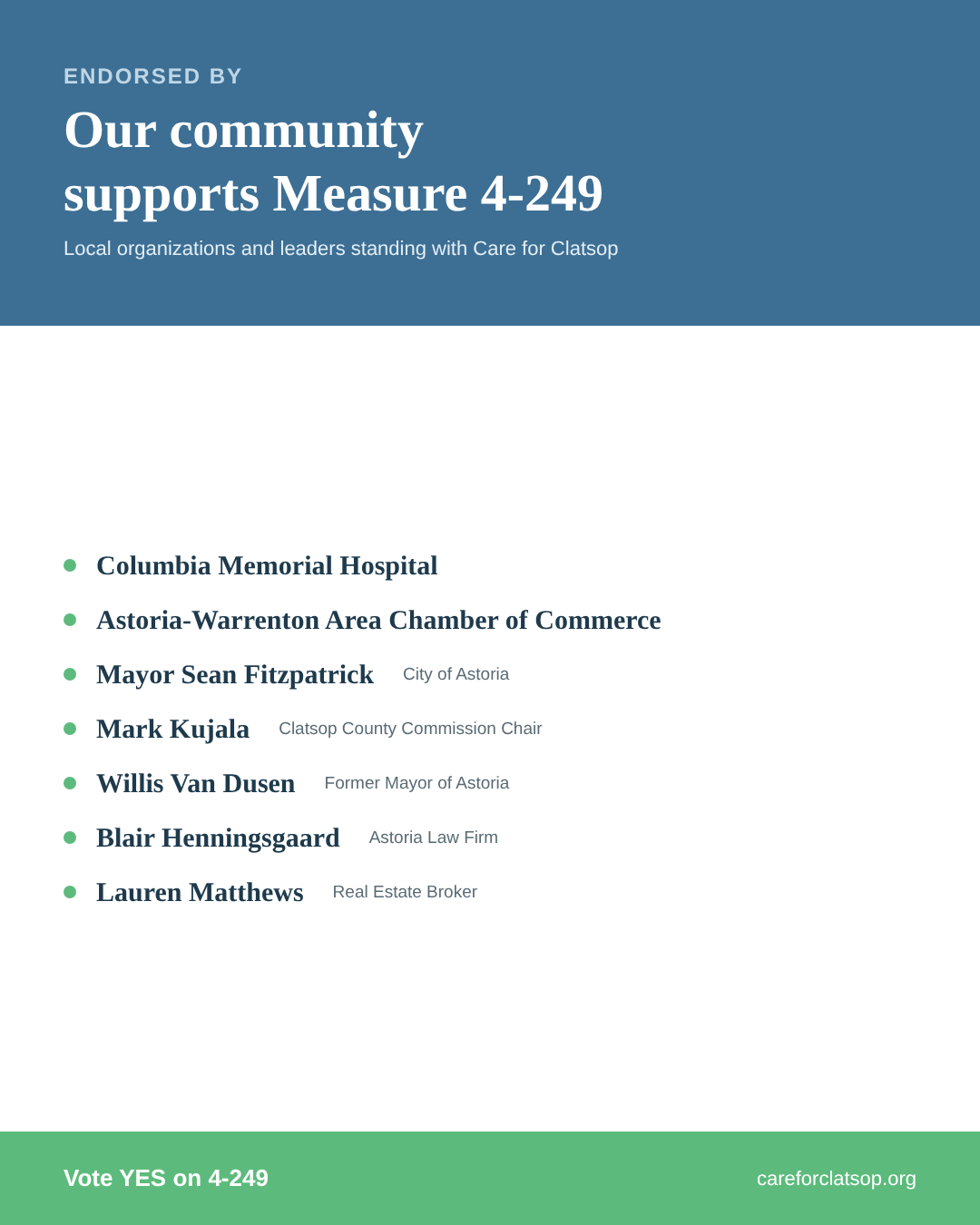
PUBLIC ran public engagement, earned media, and paid media across both tracks. The work began with relationships, not ads: a tiered outreach plan to roughly fifteen Tier 1 community institutions and about twenty more organizations, built from the board and staff's existing connections.
District funds carried informational connected TV, YouTube, five-station radio, and four direct-mail pieces. The separately funded PAC carried the Vote Yes message on Meta, Google Search, and a hyperlocal radio spot. Local voices, a physician and a current resident, carried the message rather than statistics.
On election night, Measure 4-249 passed 5,803 to 3,093, or 65.2% yes, up from a near-even start and an 11-point gain over the campaign's mid-campaign tracking poll (54%). In the final week, county ballot returns ran at 28% against 22% statewide.
Voters, board members, staff, and residents made that result. PUBLIC's lesson from the campaign: paid media can carry a message, but it cannot manufacture trust.


We work with district leaders, public agencies, project teams, bond counsel, financial advisers, and campaign committees. Public-agency information and political advocacy must be separately scoped, funded, and executed in accordance with applicable law.
Whether you are evaluating a proposal, preparing for public engagement, or approaching an election, we will help you think through the communications work ahead.